
Every business branding its workwear faces the same choice: embroidery or printing? Both give a professional finish, but they suit different jobs. Get it wrong and you pay too much, wait too long, or end up with a logo that doesn’t survive daily wear. This guide compares embroidery vs printing so you can pick the right method for your team’s uniforms.
PROCESS DEFINITIONS
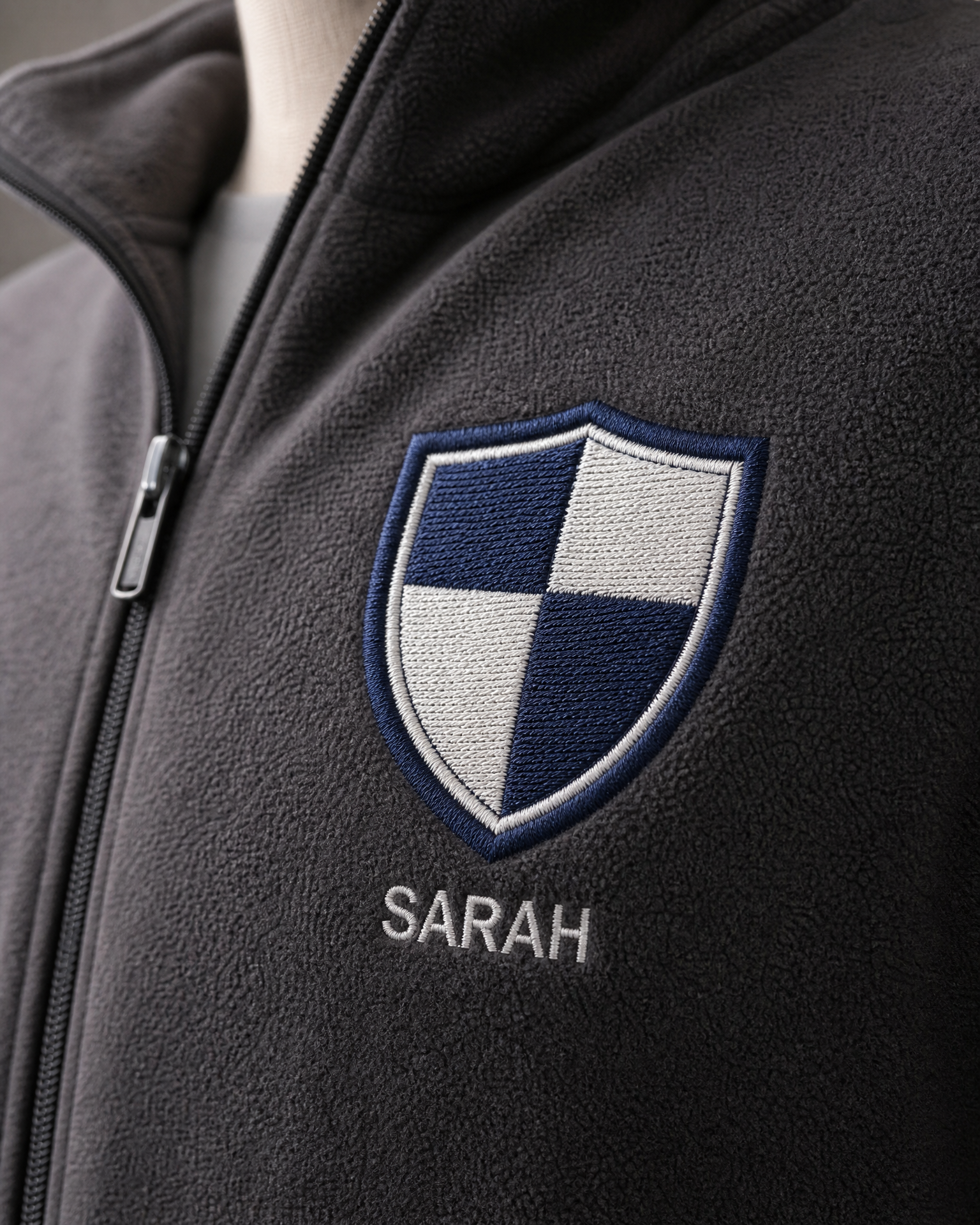
Embroidery stitches your logo into the fabric with coloured thread. We digitise your design first, which means turning it into a stitch-by-stitch map the machine can read. Then our machine sews it directly onto the garment. Read more on how we embroider a logo onto workwear.
Printing covers several methods, each applying ink or film to the surface rather than stitching into it:
Screen printing: ink pushed through a mesh screen, one colour at a time.
DTG (direct-to-garment): ink printed straight onto the fabric.
DTF (direct-to-film): the design prints onto film first, then transfers onto the garment under heat.
DTF sits between the two extremes: cheaper to set up than embroidery, and longer-lasting than most other print methods.
| Embroidery | Printing |
| Durability: Higher durability, stands up to repeated washing | Durability: Varies (requires proper care) |
| Colour and Detail: Best for clean, bold designs | Colour and Detail: Handles gradients and photographic detail well |
| Texture: Raised and tactile | Texture: Flat |
| Fabric Compatibility: Best for heavy fabrics (polos, jackets) | Fabric Compatibility: Best for lightweight fabrics |
| Best Use Case: Corporate uniforms and durable workwear | Best Use Case: Promotional events, charity T-shirts, and small runs |
Design complexity: what each method can do
Embroidery struggles with small text and fine detail. Letters under about 4mm tall blur together once stitched, and thread cannot recreate gradients or photographic images. Clean, bold logos with few colours work best.
Printing handles detail embroidery can’t. Gradients, photographic images and multi-colour designs all print cleanly, so complex or highly detailed logos usually suit print rather than thread.
Fabric and garment compatibility
The garment itself often decides the method for you.
Heavy vs lightweight fabrics
Embroidery needs a garment strong enough to carry the stitching. Polos, sweatshirts and jackets work well; thin T-shirts can pucker under dense stitching. Our embroidered workwear range is built with this in mind. Printing suits lighter garments, since it adds no weight to the fabric.
Hi-vis placement rules
EN ISO 20471, the British and European standard for high-visibility clothing, requires the retroreflective tape and fluorescent panels to stay fully visible. That makes logo placement on any hi-vis garment a safety question, not just a design one, whichever method you choose.
Waterproof and technical fabrics
Embroidery needles pierce the fabric, which can weaken waterproofing. For waterproof jackets and other technical fabrics, printing or a bonded transfer keeps the garment sealed.

Cost and order quantity
Screen printing has a lower setup cost but charges per colour, so it suits simple, high-volume orders best. DTF and digital print carry little to no setup cost, making them the better fit for small or one-off runs.
Which method suits your use case?
| Use Case | Recommended Method |
| Corporate uniforms and workwear | Embroidery |
| Promotional events, charity T-shirts and one-off runs |
Printing |
| Mixed decoration | Embroidery (chest logo) and Printing (back design) |
Caring for embroidered and printed workwear
Good care narrows the durability gap between the two methods by a long way.
– Turn embroidered garments inside out before washing to protect the stitching.
– Wash printed garments on a cooler cycle, away from harsh detergents
– For screen prints, separate colours to stop dye transfer.
Preparing your logo file
Both methods start with your logo file, so send the best version you have. Vector files give the cleanest result for both embroidery and print, because they can scale without losing resolution. A high-resolution PNG works too.
Screenshots and small website images are the least useful, since they blur once enlarged.
The same file can often serve both methods, but a logo built for one doesn’t always suit the other. A clean, bold mark embroiders well, whereas fine detail, gradients or a busy multi-colour design print far better than they stitch.
Common misconceptions
“Embroidery always costs more.” Not necessarily. At high volumes, the per-unit cost often drops below print.
“Printed logos always fade fast.” Not if you use the right method and care for the garment properly. Poor washing does more damage than the print method itself. This is one of our least favourite screen printing myths.
Get a Recommendation
Neither method beats the other outright. Embroidery suits durable, professional workwear; printing suits detailed designs, lighter fabrics and smaller runs.
If you’re not sure which fits your team, get a quote, and we’ll recommend the right method for your garments and budget.
FAQ
WHICH LASTS LONGER, EMBROIDERY OR PRINTING?
Embroidery usually lasts longer, since the thread is stitched into the fabric rather than sitting on the surface.
CAN I COMBINE BOTH METHODS ON ONE GARMENT?
Yes. Many businesses embroider a chest logo and print a larger design elsewhere on the same garment.
WHICH IS CHEAPER FOR A SMALL ORDER?
Printing, usually DTF or digital print, since neither carries embroidery’s setup cost.
WHAT’S THE MINIMUM TEXT SIZE FOR EMBROIDERY?
Aim for text at least 4mm tall. Anything smaller tends to blur once stitched.